


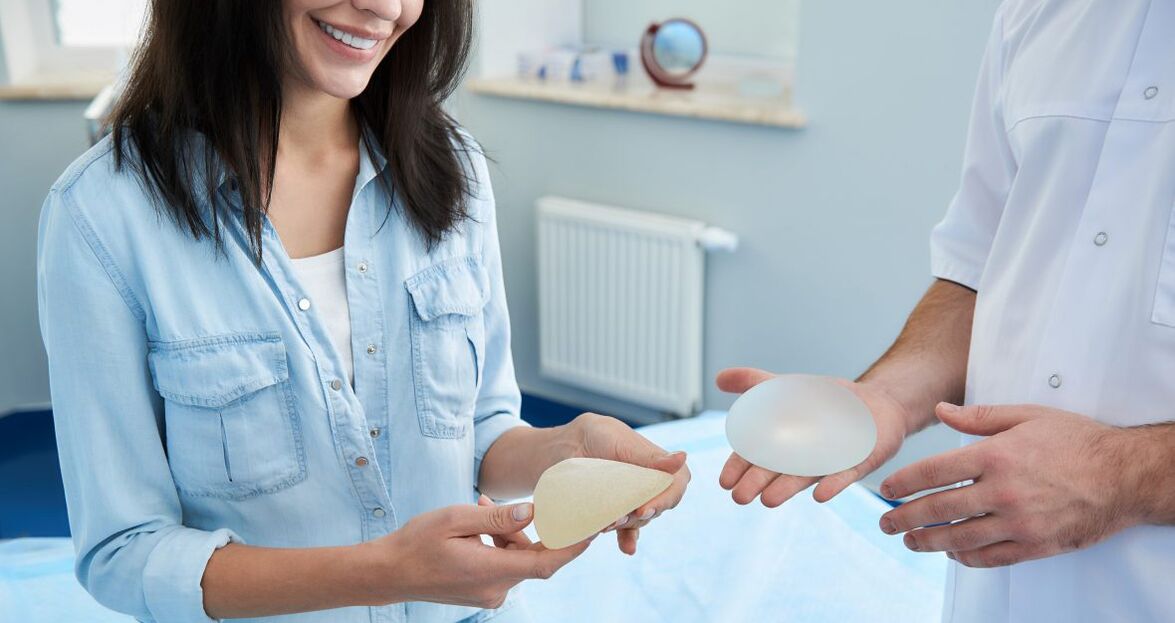
Augmentation mammoplasty is a type of plastic surgery to enlarge the breast and correct its shape.The operation is performed using special implants, which are almost in no way inferior to natural mammary glands.
What is that
Breast augmentation with implants is a plastic surgery that allows you to correct the mammary glands.This technique is used for women who have sagging breasts, changes in shape and volume, for example, as a result of childbirth or breastfeeding.
Augmentation mammoplasty is one of the surgical methods of breast enlargement and shape correction.
The surgery was determined after a thorough examination and was performed in the hospital.
In this case, implants of various shapes, contents and volumes are used, which can be installed under the fascia, gland or pectoralis major muscle.
The location of the incision may also vary.To avoid the development of complications after the intervention, it is necessary to strictly follow the rules of care.
To make the mammary gland look more natural after surgery, the specialist will give recommendations to choose the size of the implant.
Types of prostheses
All materials are divided into several types.
According to the content
They are classified into several types.
silicon
They consist of cohesive gels with varying degrees of density.The specialty of the implant is that if damaged, it does not leak.
salt
Filling: saline solution.Such products are less popular than others, but the cost will be lower.In addition, it has a shorter shelf life, and when used under the skin, lumps and bumps can form.
Installation of selected implants is the main stage of augmentation mammoplasty.
The recovery process and how painful it is depends on the correct location and contact with the tissue.
With competent actions by the surgeon, most complications can be easily avoided.
Hydrogel
This is a new generation bioimplant.It is fully compatible with the human body, which almost completely eliminates the risk of rejection.Hydrogel has many positive properties, and its quality is in no way inferior to silicone prostheses.Their advantages are flexibility, safety and non-toxicity.
By shape
Experts distinguish between round-shaped implants and teardrops.The first is used for small changes in the mammary gland.Breast augmentation with round implants is ideal for women who want to achieve a natural breast shape.
According to the type of surface and profile
The surface of the denture can be smooth or rough.
There are also high and low implants.
When choosing a product, the doctor must take into account the patient's age, weight, height, body type, sternum structure, mammary gland condition and size.
Access method
To insert the implant into the chest cavity, specialists use three types of tissue surgery, resulting in the replacement of a vacuum chamber.
Periareolar
Breast tissue is dissected at the areola location.The main advantage of this technique is that the doctor has the opportunity not only to correct the shape of the nipple, but also to change its position.
Scars after surgery almost completely disappear over time.
Submammary
An incision is made along the fold line under the breast.In terms of inconspicuous scars, this method is considered the easiest, because the stitches are located where the mammary glands cover the skin of the torso.
Axillary
Involves an incision in the area located near the armpit.The method is sloppy and more complex;the scar will be located in a visible place.In addition, in this case it is difficult to place the implant correctly in the pocket between the mammary gland and the muscle.
Prosthesis location
It can be placed under the muscle fascia, under the mammary gland, or under the pectoralis major muscle.Combination methods are often used, where several location tactics are combined at once.
Difficulty category
To determine this indicator, the following values must be taken into account:
- pointaccess;
- volumesurgical intervention;
- anatomyfeatureand the size of the desired prosthesis;
- generalconditionscustomers;
- your presencerestrictionsto operations.
Plastic surgery involves three categories of complexity.
First
Augmentation mammoplasty of the first level of complexity involves periareolar and endoprosthetic access.At the same time, this method is characterized by moderate trauma and a minimal amount of surgical intervention.
Second
The patient's condition is satisfactory.Prosthetics with vertical scars are performed;assuming moderate levels of intervention and injury.
Third
There are relative limitations that can cause complications.An anchor lift is performed, where the implant is attached.
Hint
Mammoplasty is performed not only to improve the appearance of the mammary gland, but also to eliminate deformities and other defects.
The main indications for plastic surgery include:
- smallsizebreasts;
- asymmetry;
- slackbreast or areola prolapse, which may occur against the background of rapid weight loss;
- changeformdue to lactation or childbirth;
- hyperpigmentationpacifiers;
- executed incorrectlyplasticbefore;
- deformationcongenital roundness.
However, the main factor still remains the aesthetic transformation.
Contraindications
Correction of the mammary gland using a gel or silicone prosthesis has absolute and relative limitations.
The first group includes:
- diseaseinternal organs with severe disease;
- ageup to 18 years;
- baby periodfeed;
- cancer;
- mentallyabnormalities and epileptic seizures;
- violationversatilityblood;
- infection.
Relative contraindications include:
- fibrous nodesin the mammary gland;
- bigbody weight;
- syphilisand HIV;
- chronic formhepatitis;
- diseaseautoimmunesystem, for example, rheumatism, nephritis, scleroderma;
- varicose veinsvein dilation
In addition, it is not recommended to perform surgery for diabetes mellitus in the compensation stage.The surgery should be postponed during menstruation or if there is an unreasonable increase in body temperature.
Preparation
Augmentation mammoplasty includes preparation.
The important thing is to visit several specialists.The surgeon examines the mammary glands, the condition of the skin in this area, and determines the size and volume of the breast.In addition, the doctor will tell you about the actions during the surgical procedure, the consequences and the results.
Consultation with gynecologists, mammologists and therapists will help identify any limitations to surgery.The anesthesiologist will help determine the presence of individual intolerance and the tendency to develop an allergic reaction to the drugs and substances used.
After this, the patient is referred for laboratory tests, which may include the following tests:
- blood and urine;
- biochemistry;
- for HIV, syphilis and hepatitis;
- sugar test;
- each group and Rh factor;
- coagulogram.
Instrumental examination includes fluorography, radiography, electrocardiogram and ultrasound.
In the presence of a pathological process that occurs in a chronic form, it is necessary to obtain a report from the attending physician, which will indicate the period of remission.
If no contraindications to surgical intervention have been identified, the woman should follow some recommendations at the preparation stage.
No later than a week and a half before the expected date, you need to stop smoking and drinking alcohol.Do not expose the body to stressful situations and excessive nervous tension.You also need to stop taking medications that reduce blood clotting.
Implementation techniques
Arrival at the clinic is possible the day before or directly on the day of surgical intervention.Previously, doctors may have advised patients to take sedatives at night, which will help relieve nervous tension and ensure restful sleep.In the morning at the hospital, the woman's blood pressure and body temperature were measured.
After this, the specialist administers general anesthesia.The surface of the skin in the area of the mammary gland is treated with an antiseptic solution, a catheter is installed and the body is connected to a special device that allows you to monitor the condition of the body during the operation.
After the anesthetic takes effect, the doctor proceeds directly to the manipulation itself.Cuts of the required length are made in the previously selected area.Tissue is carefully removed to form a pocket where the implant will then be placed.To stop the bleeding, the vessels are burned.
Next, the surgeon removes the endoprosthesis and installs it in the desired position through the incision.After all manipulations are completed, sutures and fixing bandages are applied to the wound.The mammary gland is supported by a shapewear, which will prevent the implant from moving laterally.
Recovery period
First of all, proper care of the wound surface is required, which will not only prevent the formation of pustular formations, but also speed up the healing process.
As a rule, self-absorbable sutures are applied to the incision and do not require removal.After about 7 days, the patient only needs to remove the nodule that will protrude above the surface of the skin.
To avoid scarring, you need to use a plaster on the seams and wear a corset.
Since in the first few days after the operation the woman will be disturbed by significant pain, the specialist will recommend taking analgesics to eliminate it.Antibiotics are prescribed to reduce the chance of infection.
To relieve the swelling, you should not take a warm bath or shower or expose your body to any physical activity for two weeks.To avoid capsular contracture, it is necessary to massage the breast, but this can be done no earlier than 2 weeks after the installation of the implant.
For 5 days you need to avoid visiting saunas, bathhouses and solariums.Tanning in direct sunlight is also prohibited.
Special attention should be paid to diet during the recovery period.Food should be light and easy to digest.You need to include more fruits and vegetables that contain iron and fortified cocktails in your diet.
Complications
All possible side effects are divided into two groups.
early
This category includes the formation of bruises, microhematomas, swelling and pain.Such phenomena are not dangerous to human health and disappear by themselves in a few days.
late
This group includes:
- openingbleeding– vascular damage contributes to the development of complications;
- seroma– appear, as a rule, a few hours after the intervention, so the patient must be in the hospital environment for 1-3 days;
- lossessensitivitynipple-areolar complex - often occurs due to damage to the touch nerve;
- hematoma;
- pusat the suture site - the main cause of complications is non-compliance with septic and antiseptic rules;
- educationkeloidscars and hypertrophied tissue;
- break ordeflation(expired) prosthesis;
- dystopiaimplants;
- capsulefibrous type contracture.
Any of the above consequences require immediate medical intervention.
Augmentation mammoplasty is a complex surgical procedure that requires a highly qualified surgeon.Therefore, before making a decision about breast augmentation with implants, you need to weigh the pros and cons and take seriously the choice of clinic where the manipulation will be performed.